As the electrification wave reaches ports and marinas, a new challenge surfaces: how to bring advanced charging technology into heritage-rich coastal environments without disrupting the visual identity that makes them unique.
Marina operators, urban planners, and public agencies aren't just asking for reliable charging — they're asking for solutions that earn approval, not resistance. At QiOn, we believe in designing technology to belong — to dialogue with its environment, not dominate it. That philosophy led to the E-Dock.
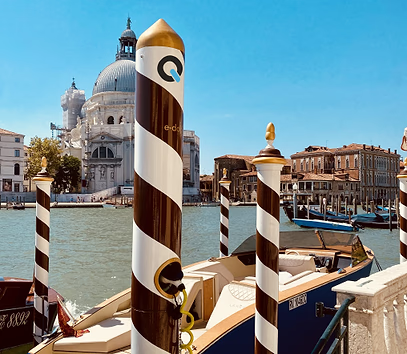
Design isn't decoration — it's the gateway to deployment
Heritage-rich coastal cities — like Venice, Amsterdam, or Cartagena — often face intense scrutiny when introducing new infrastructure. Even as the EU mandates shore power availability in major ports by 2030, a recent study showed fewer than 30% of European ports have the infrastructure in place (Reuters).
In these contexts, a charging solution that respects the visual language of its environment isn't a luxury — it's a gateway. It opens the door to faster permitting, broader community acceptance, and long-term operational continuity.
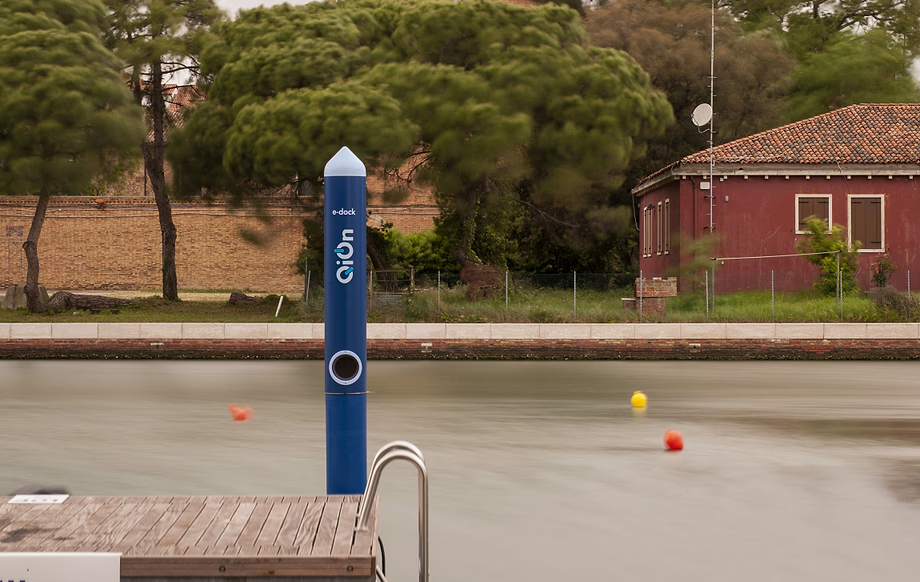
That's what the E-Dock does. Inspired by traditional Venetian mooring poles, it integrates high-performance charging into a form that coastal communities recognize and accept.
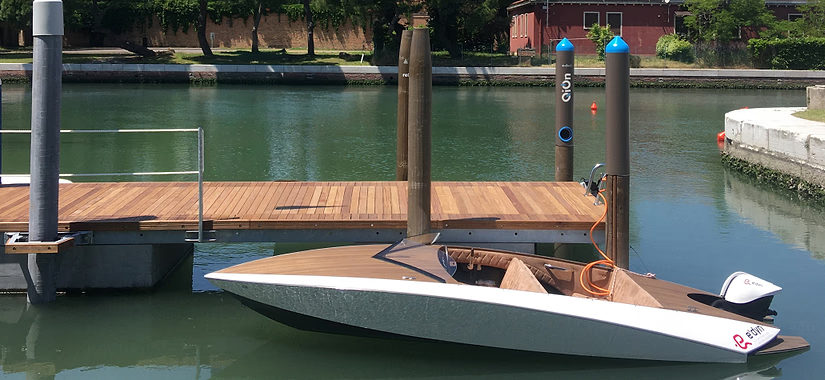
Built for the elements — and the operators
But harmony doesn't just mean aesthetics. True integration means standing up to the realities of the marine environment: constant exposure to salt air and moisture, demanding maintenance schedules, seasonal operational surges, limited access to underground cabling or grid transformers.
The E-Dock was built with these constraints in mind. It offers:
- AC output options from 7 kW to 44 kW
- IP65, IP66, and IP67 ratings for marine durability
- Marine-grade stainless steel chassis
- Modular build: anchored base + removable summit for fast maintenance
- Single and double socket options
- Optional integrated cable winder
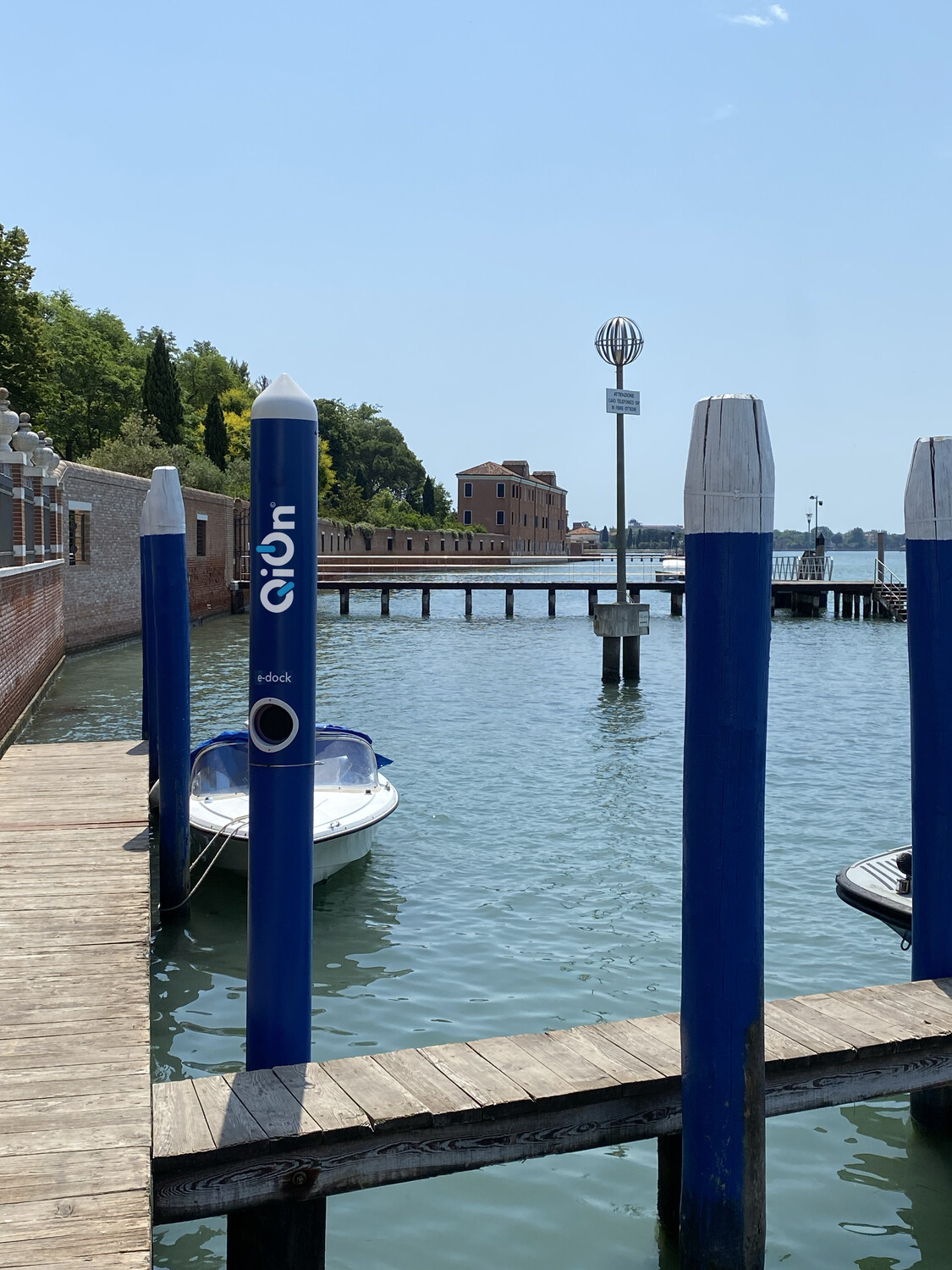
Its two-part design allows for fast deployment, while modular internals simplify maintenance — meaning less downtime and lower total cost of ownership.
Proof in place: from the Venetian Lagoon to global ports
The E-Dock was first developed to meet the aesthetic and functional constraints of Venice's lagoon — one of the world's most visually protected environments. There, it proved it could earn visual approval and deliver real-world functionality for electric ferries, taxis, and leisure vessels.
The bigger picture: regulations, ROI, and the road ahead
Global maritime electrification is no longer a pilot trend — it's an infrastructure priority. Public ports and marinas are under pressure to decarbonize operations, reduce emissions, and enable clean mobility on the water.
Yet a key hurdle remains: alignment between sustainability and local identity. The E-Dock makes that alignment possible by belonging through design. And that opens up real ROI pathways:
- Fewer permitting hurdles
- Eligibility for heritage-conscious grants
- Reduced installation complexity
- Long-term operational savings
A 2024 study from Stockholm's port electrification team showed that optimized AC/DC infrastructure with smart load management can cut operational energy costs by up to 40% (ResearchGate).
Looking to bring waterfront charging to a heritage site, an active marina or a public port? Get in touch and we'll walk through what design-led shore power looks like in your environment.